Power bank pass-through charging means the unit can accept input power while supplying power to a connected device. It can be useful when only one wall outlet is available or when several devices need an overnight charging sequence. It is not a universal power-bank feature, and it should not be treated as proof that the battery is charging quickly, that the output stays at its headline wattage, or that the unit works as an uninterrupted power supply.
The result depends on the power-path design, the input adapter, the active ports, the device load, battery state and thermal controls. When the input cannot cover the output demand and the power bank’s own charging needs, the battery may charge slowly, remain at the same level or continue to discharge even though the unit is plugged in.
Pass-through is a power-routing function, not a port count
A power bank normally contains battery cells, input and output conversion stages, protection functions and a controller that decides where power can flow. During pass-through operation, the controller has to manage the external input, the connected load and the battery at the same time.
There is more than one possible architecture. Some designs prioritize the connected device and use remaining input power to charge the battery. Others may involve the battery more directly or disable particular fast-charging modes during simultaneous operation. Texas Instruments’ overview of power-path battery chargers shows why system load, input limits and battery charging have to be managed together. That circuit-level principle explains the task, but it does not prove how any unnamed power bank implements pass-through charging.
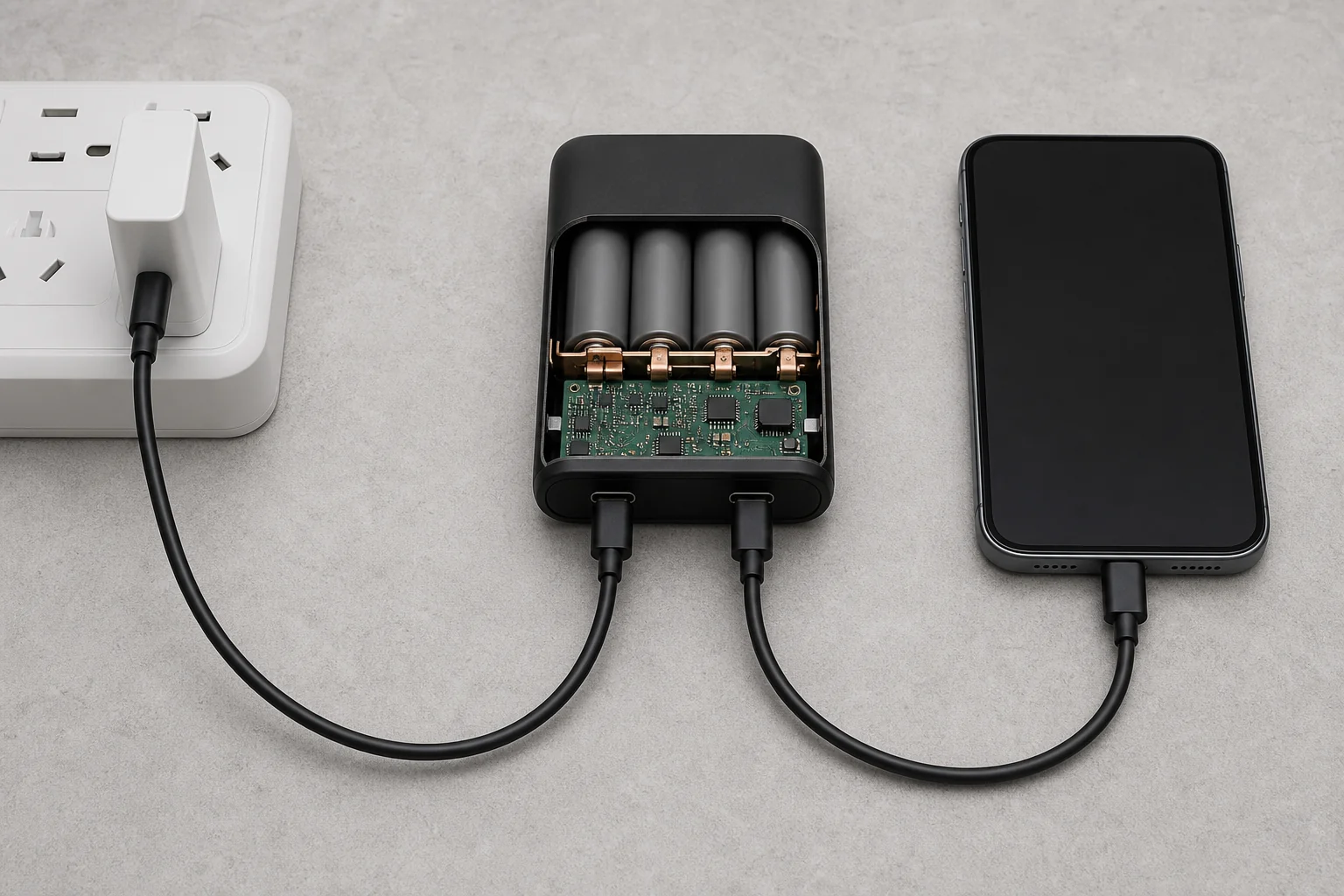
Four outcomes can look like “charging while charging”
The charging icons on the phone and power bank do not describe the full energy balance. Use the following behavior matrix to separate the likely outcomes.
| Observed condition | Likely behavior | What to verify |
|---|---|---|
| Input comfortably exceeds the active output load and internal needs | The device receives power and the power-bank battery may gain charge | Simultaneous-mode input limit, output profile and battery charge rate |
| Input is close to the total demand | The device may charge while the power-bank battery changes very slowly or remains near the same level | Whether the controller reduces battery-charging current first |
| Output demand exceeds usable input power | The battery may supplement the input and continue to discharge | Adapter rating, negotiated input, connected load and port-sharing table |
| Input is connected or removed | The output may pause, renegotiate or restart | Measured transfer behavior; do not assume UPS-like continuity |
These are operating patterns, not promised specifications. Conversion losses and control overhead mean the usable output is not simply the number printed on the wall adapter. A 30 W input does not guarantee a 30 W device output while the battery is also charging.
When pass-through charging is useful
One outlet, two charging stages
A traveler may connect the wall adapter to the power bank and the power bank to a phone so both are prepared later. This reduces the number of adapters, but the exact sequence and overnight-use guidance should come from the product manual.
A managed desk or demonstration setup
Pass-through can simplify a temporary display, tablet or phone setup where the expected load is known. The important questions are whether the output remains available, whether the battery gains or loses charge and whether the enclosure stays within its normal operating behavior.
A controlled charging queue
Some users want the connected device to receive priority and the battery to charge with remaining power. That behavior must be confirmed; “pass-through” alone does not define which load has priority.
When it is the wrong assumption
- As a guaranteed UPS: the output may briefly disconnect or renegotiate when input power changes.
- For every port combination: one USB-C port may be bidirectional while another combination is disabled.
- At the printed maximum on both sides: simultaneous mode may use lower input or output profiles.
- Inside an enclosed or hot location: simultaneous conversion can create a different thermal condition from charging or discharging alone.
- With damaged equipment: pass-through operation is not a troubleshooting method for a swollen, discolored, wet, recalled or abnormally hot power bank.
The U.S. Consumer Product Safety Commission maintains a public collection of battery and power-bank recalls. Check the exact model and follow the manufacturer or relevant local authority when damage, overheating or a recall is involved; do not use simultaneous charging to test a suspect battery.
Seven specifications to request before selecting a model
- Explicit support: the manual or approved specification should state that simultaneous input and output is supported.
- Port roles: identify input-only, output-only and bidirectional ports for every intended connector combination.
- Input profiles: record the voltage/current or USB PD profiles accepted during pass-through operation.
- Output profiles: record the per-port output available while the input is active, not only the standalone maximum.
- Power priority: confirm whether the external device, battery or another output receives priority when input power is limited.
- Transfer behavior: document whether the output pauses when the input is connected, removed or interrupted.
- Operating limits: use the exact temperature, ventilation, cable and adapter instructions for the model.
A broader power-bank selection guide can help define capacity, port and charging-protocol needs first. Pass-through should then be treated as one separately verified function, not a substitute for those core specifications.
How to evaluate pass-through behavior on a sample
Start with an undamaged sample at normal room conditions and use the specified input adapter and cables. Record the initial battery state, the input profile, the connected device and its load state. Observe the phone or load first, then the power-bank battery trend. Repeat after connecting and removing the input, and test only the port combinations named in the product specification.
For a repeatable comparison, keep the same adapter, cables, device state and observation period. If power measurement is required, use suitable equipment and a documented method; an unexplained screen photo or a single peak number is not enough to confirm the behavior.
Frequently asked questions
Does pass-through charging damage a power bank?
No universal answer applies to every design. A supported model is designed around a defined simultaneous-use condition, but heat, power limits and permitted duration remain model-specific. Follow the manual and stop using equipment that is damaged, recalled or behaving abnormally.
Why does the power-bank percentage stay the same?
The connected load may be using most of the available input power. The controller may reduce battery-charging current or the battery may supplement the load. Compare the exact input, output and priority behavior before assuming a fault.
Can a pass-through power bank replace a UPS?
Not unless the exact product is specified and verified for the required transfer behavior, load, runtime and failure mode. A consumer pass-through label does not prove uninterrupted output.
Specify the simultaneous mode separately
For a product project, define the input adapter, active ports, connected load, battery priority, acceptable interruption, operating environment and evidence required for the exact configuration. Use the power-bank category only to identify a relevant form factor; pass-through support and its limits should be confirmed for the proposed model before evaluation or final selection.