Foreign object detection, or FOD, is a protective function that helps a wireless power transmitter identify abnormal conditions associated with unintended objects near the charging field. Depending on the design, the charger may refuse to start, reduce power or stop transfer. FOD is not a universal metal detector, and one successful coin test does not prove that every object, position, phone case and power state will be handled safely.
Why foreign objects matter in inductive charging
A wireless charger transfers energy through a magnetic field between a transmitter coil and a receiver coil. A conductive object that couples to that field can develop circulating currents and heat. The result depends on the object’s material, shape, size, thickness, position and distance from the coil, as well as the power level and transmitter design. That variation is precisely why FOD must be evaluated as a system behavior rather than advertised as an absolute promise.
The Wireless Power Consortium describes foreign object detection as a safety feature in Qi Certified chargers that can stop charging when a metal object interferes. The statement supports the intended protective role; it does not mean every charger uses one identical method or can recognize every metal item before any energy is applied.
FOD can act before and during power transfer
Wireless-charging designs can evaluate the charging area at more than one stage. Before normal power transfer, a transmitter may probe for a receiver and compare the response with expected patterns. During power transfer, it can monitor operating information such as the relationship between transmitted and received power, temperature or other implementation-specific indicators. If the result crosses a defined boundary, the transmitter may limit or stop power.
The WPC’s Qi v1.3 introduction explains that receiver information supports power-loss accounting and that the specification does not prescribe one single FOD implementation. That distinction matters: conformance requirements define expected behavior and test conditions, while product designers still choose sensing, algorithms and thresholds.
| Stage | Possible system response | What the result does not prove |
|---|---|---|
| Before charging starts | Refuse or delay normal power transfer when the observed response is abnormal. | That every small or weakly coupled object will be identified. |
| Receiver negotiation | Use receiver information and protocol state to establish permitted transfer. | That any phone-shaped device is a valid, compatible receiver. |
| During transfer | Monitor loss, temperature or other implementation-specific indicators and reduce or stop power. | That surface temperature will never rise or that all objects behave alike. |
| After a trip | Remain stopped, retry or require the object/receiver to be removed, depending on design. | That restart timing and user indication are universal. |
Why false trips and missed conditions can occur
FOD is a classification problem with imperfect signals. A thick case, magnets, a metal camera ring, a misaligned receiver or normal system loss can look different from the design’s reference condition. A threshold set too aggressively may reject acceptable charging positions. A threshold set too loosely can reduce the margin for detecting a small or poorly coupled object. Coil geometry and multi-coil activation also change what the transmitter observes.
Receiver reporting is another boundary. Power-loss approaches compare energy sent by the transmitter with information from the receiver. Measurement tolerance, communication timing and calibration all affect the calculation. This does not make FOD ineffective; it means the algorithm, hardware and intended receiver set must be validated together.
User indication and recovery are part of the behavior
A charger that stops power but gives no understandable indication may leave the user repeatedly repositioning the phone without removing the object. An LED, message or other signal should therefore be evaluated together with the electrical response. Record what the indicator does during normal alignment, receiver absence, detected abnormal condition and recovery. The symbol, color or blink pattern is product-specific; do not assume that a red light always means FOD.
Recovery policy also deserves a defined test. Some transmitters may remain stopped until the receiver is removed; others may retry after a delay or after the observed condition changes. Automatic retry is neither universally required nor universally unsafe. The acceptance record should state the exact sequence, confirm that power does not cycle unexpectedly under the tested condition and verify that normal charging can resume after the area is cleared.
What a buyer should ask a supplier to document
- Applicable standard and scope. Record the Qi specification or test program revision used, the product configuration and whether the claim is certification, internal validation or a design target.
- Receiver set. Identify the exact phones or receiver fixtures used, including case and accessory conditions that matter.
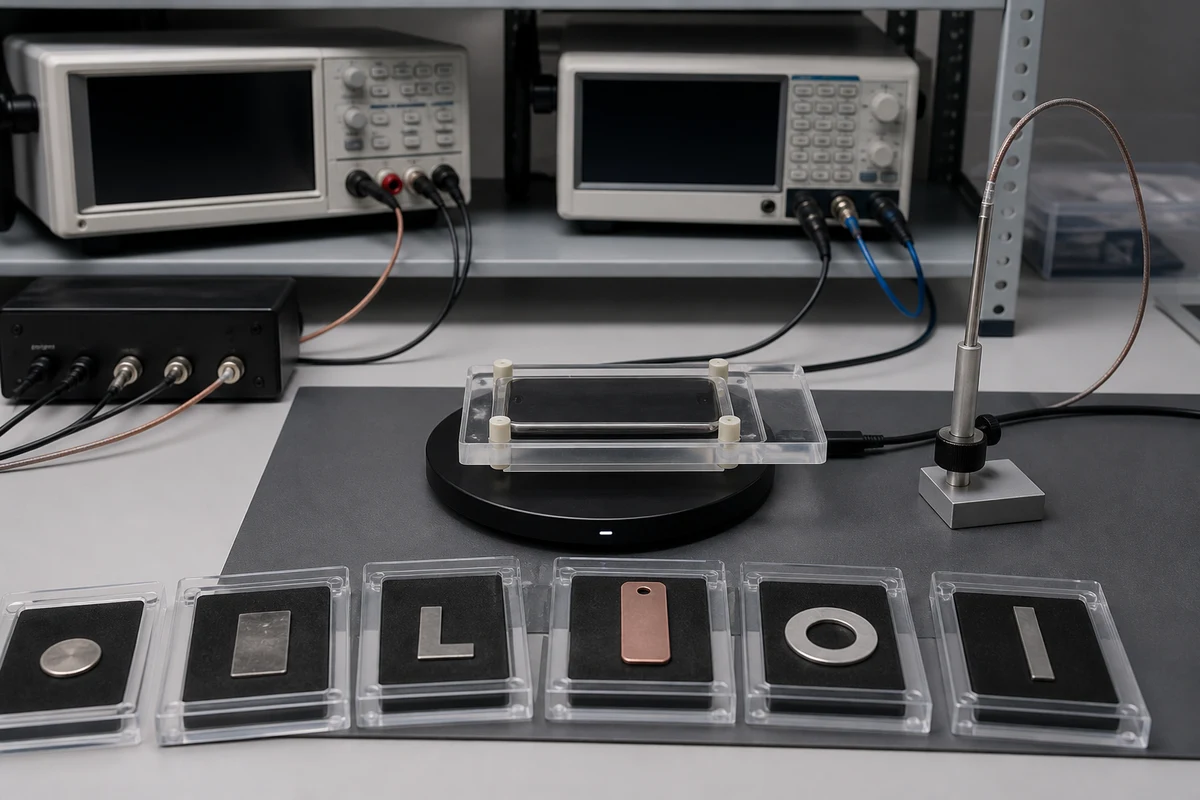
- Foreign object set. Record each object’s material, dimensions and placement instead of writing only “coin test.”
- Power states. Cover start-up, steady transfer, receiver movement, misalignment and removal/replacement where applicable.
- Observable response. State whether the charger refuses to start, reduces power, stops, indicates a fault or later retries.
- Temperature method. Define sensor location, equipment, ambient condition, duration and stop criteria. Do not compare temperatures collected by different methods as if they were equivalent.
- Sample coverage. Retain results across multiple units and relevant production lots rather than one engineering sample.
A controlled FOD evaluation sequence
- Confirm the transmitter, firmware, power adapter and receiver are the intended production configurations.
- Verify normal charging first, including alignment and user indication, so a basic compatibility fault is not misclassified as an FOD response.
- Use only the defined test objects, positions and procedures from the applicable program or documented engineering plan. Do not improvise hazardous metal or heat tests on a desk.
- Record behavior before transfer, during steady transfer and after the condition is removed.
- Monitor with appropriate instruments and pre-defined stop conditions. If there is abnormal heat, odor, discoloration, swelling, smoke or damaged hardware, disconnect power if it is safe to do so and follow the manufacturer’s safety guidance.
- Repeat with relevant receivers, cases, positions and samples. A pass is limited to the tested configuration and method.
- After changes to the coil, shielding, enclosure, firmware, adapter or thermal design, identify which FOD checks must be repeated.
What FOD does not replace
FOD does not replace basic user behavior, thermal protection, over-voltage and over-current controls, correct receiver communication, material selection or product compliance. It also does not make it acceptable to leave keys, coins or jewelry on the charging surface. For broader placement, adapter and condition checks, use the wireless charger safety guide.
How to frame an accurate product requirement
A useful requirement names the applicable Qi scope, target receivers, allowed accessories, defined foreign objects, test positions, power states, response criteria and evidence format. Avoid language such as “detects all metal” or “cannot overheat.” Those claims are broader than a realistic validation program can support.
Once the requirement and acceptance method are fixed, review the wireless charger category and request evidence for the exact model and configuration under consideration. FOD should be treated as one verified layer in a complete wireless-charging safety design—not as a substitute for the rest of that design.